Cardiovascular Risk Profile (Switzerland)
Alle Werte im Überblick – Herz-Kreislauf-Risikoprofil | easyApotheke
Cardiovascular Risk Profile (Switzerland)

Cardiovascular Risk Profile (Switzerland)

Labortest für Zuhause

Blue_and_White_Modern_Professional_General_Linkedin_Banner_3
4.6 (121 reviews)

The cardiovascular risk profile shows how your key blood values are for heart and vessels .

➤ Analyze important blood lipids and heart markers

➤ Shows risks for heart and vessels

➤ Cholesterol, inflammation & electrolytes

Comfortable blood collection through TAP

➤ Ideal for preventive & lifestyle check

➤ Results digitally accessible & comparable


89,00 €
Versand & Steuern inkl.
  • Laboranalyse im Fachlabor (ISO 15189)

  • Kostenloser Versand & Rücksendung

  • Ergebnisse digital & verständlich

Auf Lager. 3-5 Werktage Lieferzeit

The_file_must_not_be_greater_than_10240_kilobytes
Über 10.000 Bluttests durchgeführt

Welche Werte misst dieser Test?

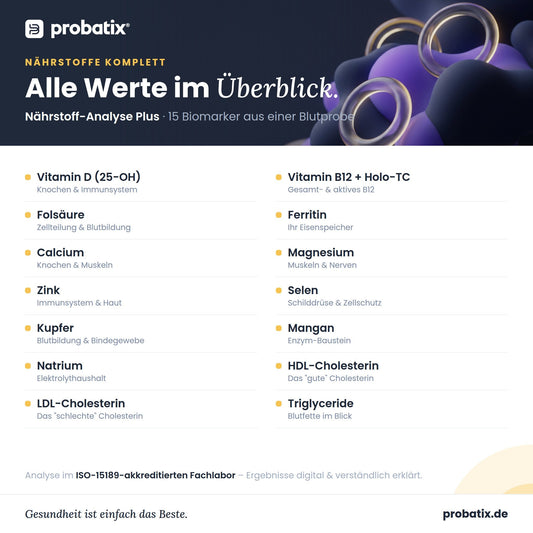
Apolipoprotein A1, Apolipoprotein B, Cholesterol, HDL cholesterol, LDL cholesterol, Triglyceride, Lipoprotein(a), CRP high-sensitive (hs-CRP), Sodium.

Eine detaillierte Übersicht aller Werte finden Sie weiter unten im Bereich „Alle Werte im Detail“.

Wie funktioniert der Test?

1. Eine Probe mit unserem Testkit entnehmen.

2. Die Probe mit vorfrankiertem Umschlag ans Labor senden.

3. Nach wenigen Tagen Ergebnisse digital einsehen.
Sind die Werte zuverlässig?
Alle bei uns angebotenen Tests werden in zertifizierten medizinischen Fachlaboren in Deutschland ausgewertet und validiert.

Can I interact with the instructor or other students during the course?

Most online courses provide avenues for interaction with instructors and fellow students. This can be in the form of discussion forums, live Q&A sessions, or dedicated community platforms. The level of interaction varies across courses, so it's worth checking if the course offers opportunities to connect with instructors or fellow learners if that's something you value.

Do you know your risk?

Cardiovascular diseases often develop unnoticed. This profile analyzes important risk factors and helps you take countermeasures early.

Cardiovascular Risk Profile (Switzerland) - Werte im Detail:

Apolipoprotein A1
Apolipoprotein A1 (Apo A-I) is the main protein of "good" HDL cholesterol. It supports the transport of excess cholesterol from the vessels to the liver, where it is broken down and excreted. Thus, Apo A-I plays a central role in protecting the vessels from calcification.

High Apo A-I levels are associated with a lower risk of cardiovascular diseases. Low levels, on the other hand, may indicate an increased risk of arteriosclerosis, especially if "bad" LDL cholesterol is also elevated.
Apolipoprotein B
Apolipoprotein B (Apo B) is the most important transport protein of the "bad" cholesterol particles such as LDL and VLDL. Since each LDL particle carries exactly one Apo B, the Apo B value directly indicates how many atherogenic particles are circulating in the blood. This makes it a very significant marker for the risk of vascular calcifications.

A high Apo B value means an increased risk of heart attack or stroke. Low values, on the other hand, are considered favorable and indicate that fewer harmful particles are present in the blood.
Cholesterol
Cholesterol is a fat-like substance that the body needs for many important functions. It is a building block of cell membranes, a precursor for hormones such as estrogen and testosterone, and for the production of bile acids. Some is absorbed through food, but the majority is produced in the liver.

Too high cholesterol levels can lead to deposits in the vessel walls and increase the risk of cardiovascular diseases. However, a balanced level is important, as cholesterol is also indispensable for health.
HDL cholesterol
HDL cholesterol is often referred to as "good cholesterol" because it transports excess cholesterol from the vessels to the liver. There, it is broken down or recycled, reducing deposits in the arteries. Thus, HDL helps to keep the vessels healthy and free from calcifications.

High HDL levels are considered beneficial as they are associated with a lower risk of cardiovascular diseases. Low levels, on the other hand, increase the risk of arteriosclerosis and heart attack.
LDL cholesterol
LDL cholesterol is referred to as "bad cholesterol" because it transports cholesterol from the liver to the body's cells. Excess LDL can deposit in the vessel walls and form so-called plaques. These deposits narrow the vessels and increase the risk of cardiovascular diseases.

High LDL levels are an important risk factor for arteriosclerosis, heart attack, and stroke. Low levels, on the other hand, are considered beneficial for vascular health.
Alle Biomarker anzeigen

Anwendung und Ablauf des Tests

Anwendung und Ablauf des Tests

Tasso DE Instructions

Bei Fragen hilft Ihnen auch immer gerne unser Support weiter: support@probatix.de
1. Probe entnehmen
In wenigen Schritten mit verständlicher Anleitung zuhause durchführbar
2. Ans Labor senden
Ganz einfach mit unserem vorfrankierten Rückumschlag
3. Ergebnis erhalten
Digital und verständlich in Ihr persönliches Gesundheitsportal
BLUTTEST FÜR ZUHAUSE - EASY APOTHEKE
ChatGPT_Image_7
Gemeinsam mit Probatix bietet easyApotheke ausgewählte Gesundheitstests zur bequemen Anwendung zuhause an.
Bild_07