Your Health in Focus – Targeted Tests for Women.
Women's Health
Women's Health

Filter
11 Products

Seller: Probatix®
Gut Flora Check
Regular Price
269,00 €
Sales price
269,00 €
Regular Price
Unit price
/pro


Premium
Seller: Probatix®
Women's Health Profile
Regular Price
240,00 €
Sales price
240,00 €
Regular Price
270,00 €
Unit price
/pro

Seller: Probatix®
Nutrient Analysis Plus
Regular Price
239,00 €
Sales price
239,00 €
Regular Price
Unit price
/pro


Premium
Seller: Probatix®
Fertility Analysis
Regular Price
170,00 €
Sales price
170,00 €
Regular Price
Unit price
/pro


Premium
Seller: Probatix®
Menopause Profile
Regular Price
165,00 €
Sales price
165,00 €
Regular Price
Unit price
/pro


Premium
Seller: Probatix®
Burnout Risk Test
Regular Price
155,00 €
Sales price
155,00 €
Regular Price
Unit price
/pro

Seller: Probatix®
Thyroid Profile
Regular Price
89,00 €
Sales price
89,00 €
Regular Price
Unit price
/pro

Seller: Probatix®
HPV Risk Type Test
Regular Price
85,00 €
Sales price
85,00 €
Regular Price
Unit price
/pro

Seller: Probatix®
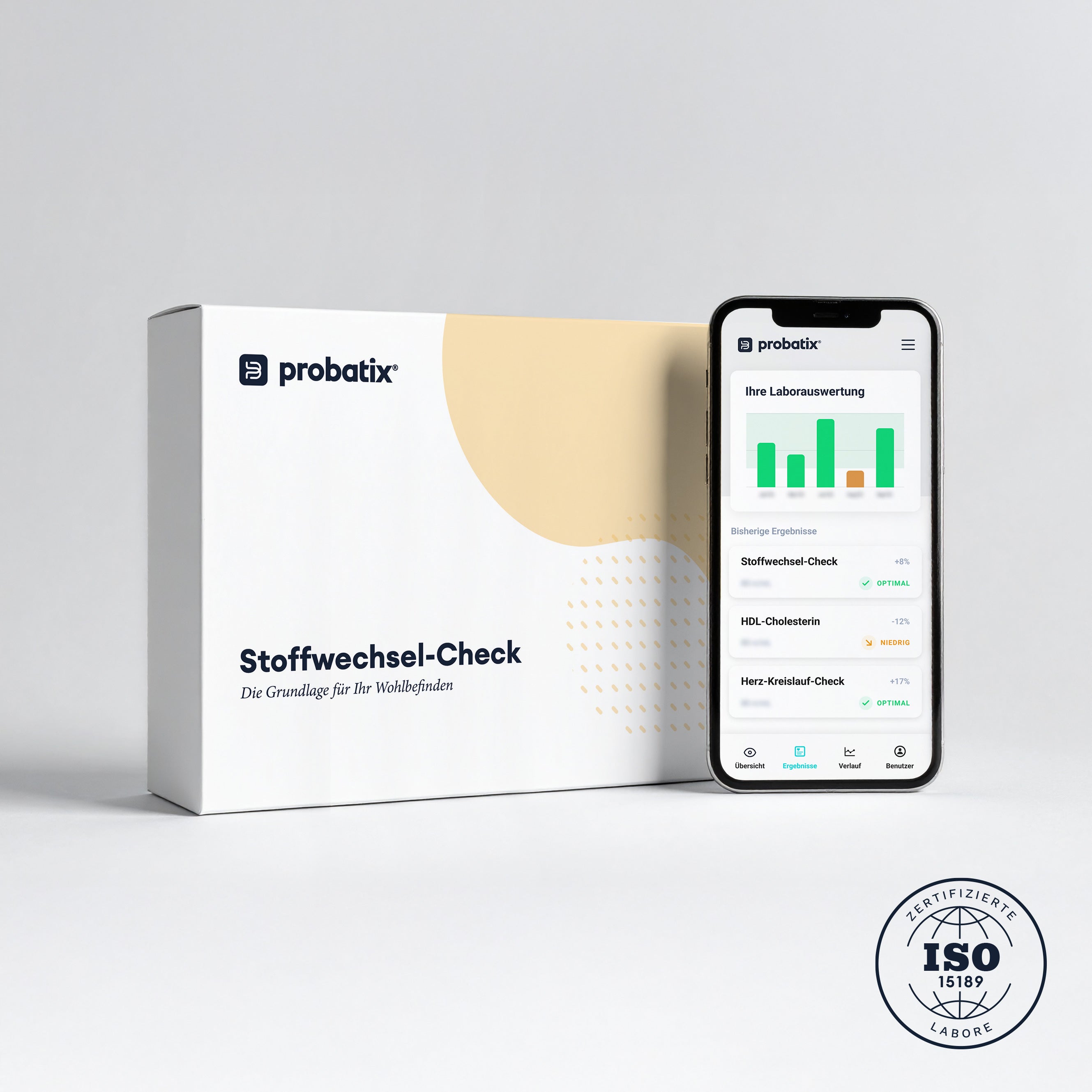
Metabolism Profile
Regular Price
69,00 €
Sales price
69,00 €
Regular Price
Unit price
/pro


Seller: Probatix®
Ovarian Reserve Test (AMH)
Regular Price
65,00 €
Sales price
65,00 €
Regular Price
Unit price
/pro


Seller: Probatix®
STI Check Basic – Women
Regular Price
59,00 €
Sales price
59,00 €
Regular Price
Unit price
/pro
x
Too many tests to choose from?
Our digital health advisor helps you find the right blood test for your symptoms or preventive care.

Which diseases can be detected in the blood?
Blood values can provide important indications of diseases. These include, for example, inflammations, infections, diabetes, lipid metabolism disorders, hormonal changes, or deficiencies such as iron or vitamin D deficiency.
Which blood tests can be done at home?
With Probatix, you can conveniently determine many relevant blood values at home. These include, among others, vitamin and mineral levels, cholesterol, metabolic markers such as HbA1c, as well as selected hormone levels.
The sample is taken via a finger prick, and the analysis is carried out by a certified specialist laboratory.
Can you test your own blood at home?
Yes, you can collect your blood sample at home yourself. With Probatix, this is done with a simple finger prick. You then send the collected sample to a certified specialist laboratory, where it is analyzed under strict quality standards.
Important: The evaluation does not take place at home, but in the laboratory. It is precisely there that the necessary equipment, controls, and medical standards are available to ensure precise and reliable results.
This way, you combine convenient home collection with the quality of professional laboratory diagnostics.
How do home blood test kits work?
A blood test kit from Probatix works simply: You choose your test, take the sample via finger prick, send it to the lab, and receive your results digitally.
The analysis is conducted in a certified specialist laboratory – clearly prepared and securely accessible.
Which blood values should a woman have tested?
Which values are sensible depends on age, life phase, and complaints. Frequently relevant are:
Iron (Ferritin)
Vitamin D and Vitamin B12
Thyroid value (TSH)
Cholesterol levels
Blood sugar (HbA1c)
hormone levels depending on the situation
With a targeted blood test from Probatix, women can conveniently have their most important health markers checked at home – the analysis is carried out in a certified specialist laboratory.
Which hormones should a woman have tested?
Depending on the question, different hormones are relevant. These include, among others:
Estradiol
Progesterone
FSH and LH
Testosterone
Prolactin
TSH (thyroid)
A hormone profile from Probatix can help better classify cycle irregularities, desire for children, mood swings, or hormonal changes. The sample is taken at home via finger prick, and the analysis is conducted in a specialized laboratory.
What does a complete blood count include for a woman?
A classic comprehensive blood count includes the analysis of red and white blood cells, hemoglobin, hematocrit, and other basic values.
Additionally, depending on the need, extra markers such as iron, thyroid values, blood sugar, or cholesterol can be added.
With Probatix, selected laboratory values can be conveniently determined at home. It is important to note: A complete comprehensive blood count in the strict sense is traditionally created from venous blood in the laboratory.
Which 3 blood values are important for women?
Three particularly frequently relevant values for women are:
Ferritin (iron) – especially in cases of fatigue or heavy menstruation
TSH (thyroid) – in cases of weight fluctuations or low energy
Vitamin D – important for the immune system and bone health
With a suitable profile from Probatix, these values can be specifically checked – as a basis for prevention or further medical clarification.
10% discount on the next test
Health knowledge, blood test insights, and benefits for subscribers
What does a blood test for women's health show?
A blood test for women's health can help better categorize important values related to hormones, cycle, menopause, thyroid, nutrients, iron, vitamin D, blood sugar, liver, kidneys, and inflammation. Especially in cases of symptoms like fatigue, hair loss, weight gain, cycle disorders, exhaustion, PMS, desire to have children, or menopausal complaints, a targeted blood test can be useful.
In addition to a normal blood count, values such as ferritin, vitamin D, vitamin B12, TSH, fT3, fT4, estrogen, progesterone, testosterone, cortisol, HbA1c, kidney values, or liver values can be checked depending on the situation. A hormone test for women, hormone test women, hormone check, blood count hormones, or a hormone examination for women can help categorize complaints not just by feeling but based on concrete values.
Which hormones are particularly important for women?
For women, estrogen, progesterone, testosterone, LH, FSH, prolactin, cortisol, and thyroid hormones play an important role. They influence the cycle, skin, hair, mood, sleep, weight, energy, and fertility. If symptoms persist for a longer period, it may be advisable to have hormone levels tested and to consider the values in relation to the cycle phase and symptoms.
It is particularly often about estrogen and progesterone, measuring estrogen levels, testing estrogen, measuring progesterone, estrogen and progesterone test, estrogen and progesterone deficiency, progesterone deficiency test, low progesterone, symptoms of too little progesterone, too much estrogen, lowering estrogen levels, estrogen dominance diet, symptoms of estrogen deficiency and progesterone deficiency, and the question of when a hormone disorder test is advisable.
When should a hormone test be done during menopause?
During menopause, hormone levels and cycles often change gradually. Many women first notice irregular bleeding, sleep problems, hot flashes, mood swings, weight gain, hair loss, or exhaustion. A menopause blood test, menopause hormone test, or menopause test at the doctor can help better classify symptoms, even though the diagnosis often also involves symptoms and cycle progression.
A test can be useful if it is unclear whether symptoms are caused by menopause or the thyroid. This is because menopause and thyroid, hypothyroidism and menopause, or an estrogen deficiency hypothyroidism can cause similar symptoms. Terms like testing menopause hormone levels, menopause test, determining menopause, pregnant or menopause test, menopause women test, menopause at 40 test, and menopause diagnostics fit precisely in this area.
Why do menopause often cause fatigue, lethargy, or lack of drive?
Fatigue during menopause can be exacerbated by hormonal changes, sleep problems, stress, iron deficiency, thyroid issues, vitamin D deficiency, B12 deficiency, or blood sugar fluctuations. If one feels permanently tired and exhausted, tired and worn out, tired and weak, just tired and weak, or only tired and weak, it is worth taking a broad look at blood values and lifestyle.
Especially complaints such as menopause fatigue, menopause exhaustion, menopause total exhaustion, menopause exhaustion experiences, fatigue concentration weakness, tired weak listless sweating menopause, or fatigue hormones should not just be dismissed as "normal." Questions like does progesterone make you tired, always tired in the afternoon, tired which deficiency, or overweight showing fatigue indicate that hormones, nutrients, and metabolism are often interconnected.
Which blood values are important for hair loss, thinning hair, and hair changes?
Hair loss and changes in hair structure can be related to hormones, iron deficiency, thyroid, stress, nutrient deficiency, or menopause. A hair loss blood test can therefore consider values such as ferritin, iron, TSH, fT3, fT4, vitamin D, B12, zinc, and inflammation markers. Especially in cases of fatigue and hair loss, hair loss with weight gain, or cycle changes, the causes should be examined more closely.
During menopause, many women report thin hair menopause, hair loss during menopause, greasy hair menopause, menopause hair dry, hair breakage menopause, menopause hair breaking off, hair breaking off hormones, hair breaking off at the roots hormones, or eyebrows falling out menopause.Changes such as suddenly curly hair during menopause, suddenly curls menopause, previously straight hair now curls, changes in hair structure, hair suddenly curling, straw-like hair cause, brittle hair causes, or flyaway hair disease can be reasons to check hormones and nutrients.
What role do iron, ferritin, vitamin D, and B12 play in women?
Iron and ferritin are particularly important for women because menstrual bleeding, pregnancy, diet, or significant blood loss can deplete the stores. An iron test, testing iron, iron deficiency blood test, iron blood test, or blood test for iron can help identify a deficiency. Typical indications include low ferritin levels, symptoms of low ferritin levels, fatigue due to iron deficiency, fatigue due to iron, normal iron levels in women, and the question of what is advisable to do in case of iron deficiency.
Vitamin D and B12 are also among the important values. A vitamin D test, vitamin D blood test, vitamin D blood count, vitamin D blood draw, measuring vitamin D3 levels, or at-home vitamin D test can indicate if there is a deficiency. Regarding B12, it often concerns B vitamin B12, B12 deficiency, B12 deficiency symptoms, B-vitamin deficiency symptoms, B-vitamin deficiency: symptoms, benefits of B12, remedying B12 deficiency, consequences of B12 deficiency, effects of vitamin B12 deficiency, and signs of vitamin B deficiency.Especially with vegan or vegetarian diets, pregnancy, fatigue, or neurological complaints, these values should not be overlooked.
Which values are important for fertility, pregnancy, and cycle?
When trying to conceive, hormones, thyroid, vitamin D, iron, B12, zinc, AMH, LH, FSH, prolactin, and progesterone can be relevant. An anti-Müllerian hormone test can provide insights into ovarian reserve but should always be considered in context. Values such as anti-Müllerian hormone too high, anti-Müllerian hormone menopause, or terms like fertility genetic test, genetic test fertility, genetic compatibility fertility, genetic examination fertility, genetic counseling pregnancy, fertility vitamin D, vitamin D progesterone deficiency, zinc fertility, and LH level male show that fertility often involves multiple areas.
During pregnancy, additional examinations are added.This includes pregnancy examinations, pregnancy tests, tests during pregnancy, tests in pregnancy, which pregnancy examinations, which tests during pregnancy, NIPT test duration, when NIPT, how long NIPT test, when to do NIPT test, NIPT result duration, non-invasive prenatal test, and non-invasive prenatal diagnostics. Also, the HCG progression in pregnancy, HCG level at 4 weeks, HCG increase in pregnancy, HCG level by week, HCG development, or an HCG level after miscarriage can be medically relevant and should be assessed by a doctor.
What does it mean if the period is absent or PMS becomes stronger?
If the period does not come, there can be many reasons: stress, weight changes, thyroid, PCOS, pregnancy, menopause, underweight, medication, or hormonal changes. A blood test can help narrow down possible causes. Especially when the period is absent, overdue but not pregnant, not pregnant no period, why am I not getting my period, what to do if the period does not come, how long is it normal to be overdue, two months no period, nausea and no period but not pregnant, or what if you don't get your period, you should not wait indefinitely.
PMS can also change with age.Terms like PMS menopause, PMS diagnosis, premenstrual syndrome test, when does PMS start, premenstrual syndrome during menopause, PMS menopause experiences, PMS hormones, PMS worse after 40, PMS weight gain, menopause premenstrual syndrome, and menopause headaches indicate that cycle, hormones, thyroid, and nutrients should often be considered together.