Focus: Liver, Kidney, Metabolism, Gut Health
Organs & Metabolism
Organs & Metabolism

Filter
12 Products

Seller: Probatix®
Colon Cancer Screening
Regular Price
31,00 €
Sales price
31,00 €
Regular Price
Unit price
/pro

Seller: Probatix®
Nutrient Analysis Plus
Regular Price
239,00 €
Sales price
239,00 €
Regular Price
Unit price
/pro


Premium
Seller: Probatix®
Men's Health Profile
Regular Price
189,00 €
Sales price
189,00 €
Regular Price
Unit price
/pro

Seller: Probatix®
Liver Profile
Regular Price
42,00 €
Sales price
42,00 €
Regular Price
Unit price
/pro


Premium
Seller: Probatix®
Women's Health Profile
Regular Price
240,00 €
Sales price
240,00 €
Regular Price
270,00 €
Unit price
/pro

Seller: Probatix®
Thyroid Profile
Regular Price
89,00 €
Sales price
89,00 €
Regular Price
Unit price
/pro

Seller: Probatix®
Metabolism Profile
Regular Price
69,00 €
Sales price
69,00 €
Regular Price
Unit price
/pro

Seller: Probatix®
Energy Status
Regular Price
159,00 €
Sales price
159,00 €
Regular Price
Unit price
/pro


Premium
Seller: Probatix®
Nutrient Analysis
Regular Price
135,00 €
Sales price
135,00 €
Regular Price
Unit price
/pro

Seller: Probatix®
Kidney Profile
Regular Price
69,00 €
Sales price
69,00 €
Regular Price
Unit price
/pro

Seller: Probatix®
Gut Flora Check
Regular Price
269,00 €
Sales price
269,00 €
Regular Price
Unit price
/pro
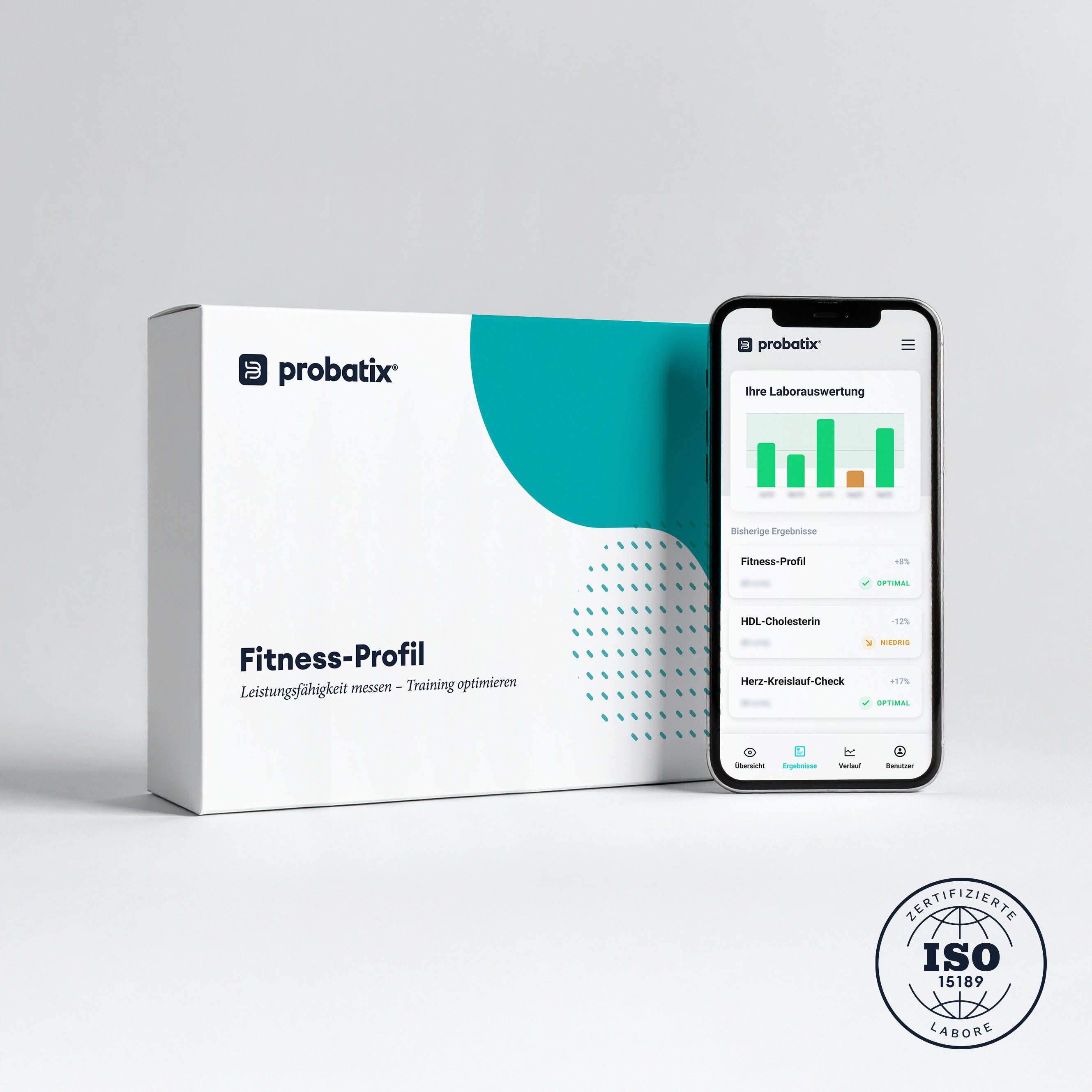

Seller: Probatix®
Fitness Profile
Regular Price
139,00 €
Sales price
139,00 €
Regular Price
Unit price
/pro
x
Too many tests to choose from?
Our digital health advisor helps you find the right blood test for your symptoms or preventive care.

Which diseases can be detected in the blood?
Blood values can provide important indications of diseases. These include, for example, inflammations, infections, diabetes, lipid metabolism disorders, hormonal changes, or deficiencies such as iron or vitamin D deficiency.
Which blood tests can be done at home?
With Probatix, you can conveniently determine many relevant blood values at home. These include, among others, vitamin and mineral levels, cholesterol, metabolic markers such as HbA1c, as well as selected hormone levels.
The sample is taken via a finger prick, and the analysis is carried out by a certified specialist laboratory.
Can you test your own blood at home?
Yes, you can collect your blood sample at home yourself. With Probatix, this is done with a simple finger prick. You then send the collected sample to a certified specialist laboratory, where it is analyzed under strict quality standards.
Important: The evaluation does not take place at home, but in the laboratory. It is precisely there that the necessary equipment, controls, and medical standards are available to ensure precise and reliable results.
This way, you combine convenient home collection with the quality of professional laboratory diagnostics.
How do home blood test kits work?
A blood test kit from Probatix works simply: You choose your test, take the sample via finger prick, send it to the lab, and receive your results digitally.
The analysis is conducted in a certified specialist laboratory – clearly prepared and securely accessible.
Do blood tests indicate organ problems?
Yes, certain blood values can provide indications of organ problems. For example, liver values (ALT, AST, GGT) provide information on liver function, creatinine and eGFR on kidney function, and certain markers give indications on the thyroid or pancreas.
A blood test from Probatix can specifically check such values. However, abnormal results should always be clarified by a doctor, as laboratory values allow for an assessment but do not replace a complete diagnosis.
Which diseases can be detected in the blood?
Blood tests can provide indications of numerous diseases. These include, among others, diabetes, lipid metabolism disorders, inflammations, hormonal disorders, deficiencies, or dysfunctions of the liver and kidneys.
With targeted laboratory analyses from Probatix, relevant markers can be determined and viewed digitally. The crucial factor is the medical classification in connection with your symptoms.
Can the metabolism be detected in the blood?
Yes, metabolism can be assessed through various blood values. These include blood sugar, HbA1c, cholesterol, triglycerides, thyroid hormones, and liver values.
A metabolic profile from Probatix can help detect abnormalities early and make potential risk factors visible.
How useful is a metabolic analysis?
A metabolic analysis can be particularly useful in cases of fatigue, weight gain, energy slumps, or a family history of diabetes or cardiovascular diseases.
With a targeted analysis from Probatix, you receive a well-founded overview of relevant metabolic markers – conveniently collected at home and evaluated in a certified specialist laboratory.
It is important to note: A metabolic analysis does not replace medical diagnostics, but it can be a valuable basis for preventive measures or further clarification.
10% discount on the next test
Health knowledge, blood test insights, and benefits for subscribers
What does a blood test show for organs and metabolism?
A blood test for organs and metabolism helps to better classify important body functions. Among other things, liver values, kidney values, thyroid values, blood lipids, blood sugar, inflammation values, iron values, and certain heart values can be examined. Those who want to do a metabolism blood test usually want to know if symptoms such as fatigue, lack of drive, weight gain, susceptibility to infections, digestive problems, or poor blood values are related to organs or metabolic processes.
A comprehensive blood test, a complete blood count, or a blood analysis can provide many clues. Nevertheless, a comprehensive blood count does not automatically show all organ and metabolism values. Therefore, it is important to know which blood values are important, which blood tests are available, what is examined in a comprehensive blood count, and what a comprehensive blood count indicates.
Which blood values should be examined for organs and metabolism?
Which blood values are useful depends on the symptoms and the purpose of the examination. For a general overview, a small or large blood count, liver values, kidney values, thyroid values, blood sugar, cholesterol, triglycerides, iron status, vitamin D, vitamin B12, and inflammation values can be important. Terms like values large blood count, blood analysis, elevated blood values, blood values too high, which values in large blood count, large blood count general practitioner, and large blood count doctor help with the evaluation.
Many lab reports contain abbreviations that are difficult to understand at first glance. Therefore, a laboratory values abbreviations table, a table for blood values, blood values abbreviations, blood count abbreviations, blood count abbreviations table, laboratory values table, platelet abbreviation, leukocyte abbreviation, kidney values abbreviation, and kidney values blood abbreviation are helpful to better classify values.
What do reference values and normal values mean in a blood test?
For each laboratory value, there is a reference value or reference range. This range indicates which values are considered normal for many healthy individuals. However, a value outside the reference range does not automatically mean a disease. What is crucial is how much the value deviates, whether there are symptoms, and whether other blood values are also abnormal.
Therefore, terms like previous value, reference range blood values, what is a reference value, reference value meaning, what does reference range mean, reference range negative, reference range negative meaning, laboratory reference values, reference values blood, blood count reference values, normal blood values, and reference evaluation range should always be considered in context. Comparing with previous blood values is particularly important because a single value may be less informative than a change over time.
Which liver values are important?
The liver is central to detoxification, fat metabolism, sugar metabolism, hormone breakdown, and the processing of alcohol. During an organ and metabolism check, liver values such as Gamma-GT, GPT, GOT, bilirubin, or alkaline phosphatase are often considered. Those who want to check their liver often look for normal liver values, what is normal for liver values, normal Y-GT value, overloaded liver, natural liver detoxification, or a liver detoxification test.
Alcohol can also affect liver values.Inquiries such as how long alcohol is detectable in the blood, how long alcohol is detectable in the blood liver values, CDT value alcohol how long detectable, MCV value alcohol, how long can alcohol be detected in the blood, how quickly the liver recovers, how long the liver takes to regenerate, how quickly the liver regenerates, 1 week without alcohol liver values, 10 days without alcohol liver values, 14 days without alcohol liver values, 2 weeks without alcohol liver values or 3 weeks without alcohol liver values show that many want to actively improve their values. It is important: Liver values can recover, but should be medically clarified if there are abnormalities.
Which kidney values are examined in the blood?
The kidneys regulate fluid balance, electrolytes, blood pressure, and the excretion of metabolic products. Important kidney values include creatinine, eGFR, urea, and electrolytes. In laboratory reports, terms like blood kidney values, blood values kidneys, normal kidney values, blood values kidney insufficiency, what kidney values exist, which blood values indicate kidney problems, kidney function test, test kidney function, or test kidney function often appear.
A blood test can provide indications of impaired kidney function, but depending on the situation, it does not replace a urine test or further examination. Especially if poor blood values were detected in the hospital or kidney values are conspicuous, it should be clarified whether medications, fluid deficiency, high blood pressure, diabetes, or other diseases play a role.
What role does the thyroid play for organs and metabolism?
The thyroid gland influences energy consumption, cardiovascular system, temperature sensation, weight, cycle, skin, hair, and mood. Therefore, a thyroid dysfunction can trigger many different complaints. In case of suspected hyperfunction or hypofunction, values such as TSH, fT3, and fT4 are important. Related to this are thyroid hyperfunction blood values, thyroid hyperfunction test, thyroid dysfunction test, thyroid hyperfunction symptom test, thyroid test, T3 T4 TSH test, FT3 value, T3 value, FT4 hormones, and FT4 value normal.
Additionally, reference values for the thyroid, normal thyroid values, blood values TSH, normal TSH value for women, normal thyroid values, thyroid values laboratory, T3 and T4 values, normal thyroid values for women, what are normal thyroid values, normal TSH thyroid values, and thyroid value in blood help in classification.Complaints such as burning tongue, hypothyroidism, trembling hands thyroid, fatigue hair loss lack of drive weight gain, or a brown spot on the neck thyroid should not be considered in isolation, but together with laboratory values and symptoms.
What happens with hypothyroidism or incorrect L-thyroxine dosage?
An underactive thyroid can cause fatigue, weight gain, sensitivity to cold, depressive mood, hair loss, menstrual cycle disorders, or lack of drive. Therefore, people often ask what causes an underactive thyroid, how to detect an underactive thyroid, and what is advisable to do for an underactive thyroid. An underactive thyroid after stopping the pill, an underactive thyroid with missed periods, untreated underactive thyroid, untreated underactive thyroid, or underactive thyroid with circulatory disorders can also play a role in the diagnosis.
Those taking L-Thyroxine should have their levels checked regularly. Both too little L-Thyroxine symptoms and too much L-Thyroxine symptoms can cause discomfort.Questions such as what happens if you don't take L-Thyroxine, symptoms of not taking thyroid tablets for a longer period, or L-Thyroxine depression should be discussed with a doctor, as dosage, timing of intake, and blood values need to match.
Which blood values are important for heart, cholesterol, and heart failure?
For heart and circulation, cholesterol levels, triglycerides, inflammation markers, and depending on the question, specific heart values are important. High cholesterol levels can be related to diet, genetics, thyroid, weight, exercise, and metabolism. Therefore, topics such as high cholesterol diet, high cholesterol despite healthy diet and exercise, high cholesterol levels diet, lowering high cholesterol levels, what not to eat with high cholesterol, high cholesterol levels, too high blood fat levels, bread cholesterol, high cholesterol despite vegan diet, high cholesterol levels symptoms, and too high cholesterol levels are relevant.
In case of heart failure, NT-proBNP can be an important value. Terms like NT BNP, BNP Pro, NT-proBNP value, ProBNP, Pro-BNP value, n-terminal pro BNP, BNP blood value significance, how meaningful is the BNP value, NT-proBNP too high, ProBNP elevated, Pro NT BNP, and NT-proBNP values table belong in this area.In the case of decompensated heart failure, decompensated heart failure symptoms, heart failure cough, heart weakness cold feet, blue hands heart failure, blue feet heart, heart too weak or when the heart feels weak, one should not wait but seek medical clarification.