1. Take sample
2. Send to lab
3. Receive result
Bei Fragen hilft Ihnen auch immer gerne unser Support weiter: support@probatix.de
Our customer reviews
Unsure about the selection?

More products






















Can I have a blood test without a general practitioner?
Yes, certain laboratory tests can now be conducted without a direct appointment with your general practitioner through validated home tests. You take a small blood sample at home and have it analyzed in a medical laboratory. This way, you can keep an eye on important health metrics.

How reliable are at-home blood tests?
The crucial factor is that the analysis is conducted in a quality-assured laboratory using standardized methods. Then, blood tests with capillary blood are generally just as reliable as a blood draw in the practice. With clear instructions and certified partner laboratories, Probatix ensures that you can rely on your results.

Why should I take a test with Probatix instead of at the doctor's?
At Probatix, you can start blood tests flexibly at home - without waiting rooms, with clear step-by-step instructions and analysis in certified specialist laboratories. The results are prepared digitally, comprehensibly, and trackably, so you can easily monitor developments over time. This way, you can complement traditional medical care with comfortable, data-supported monitoring of your health with Probatix.
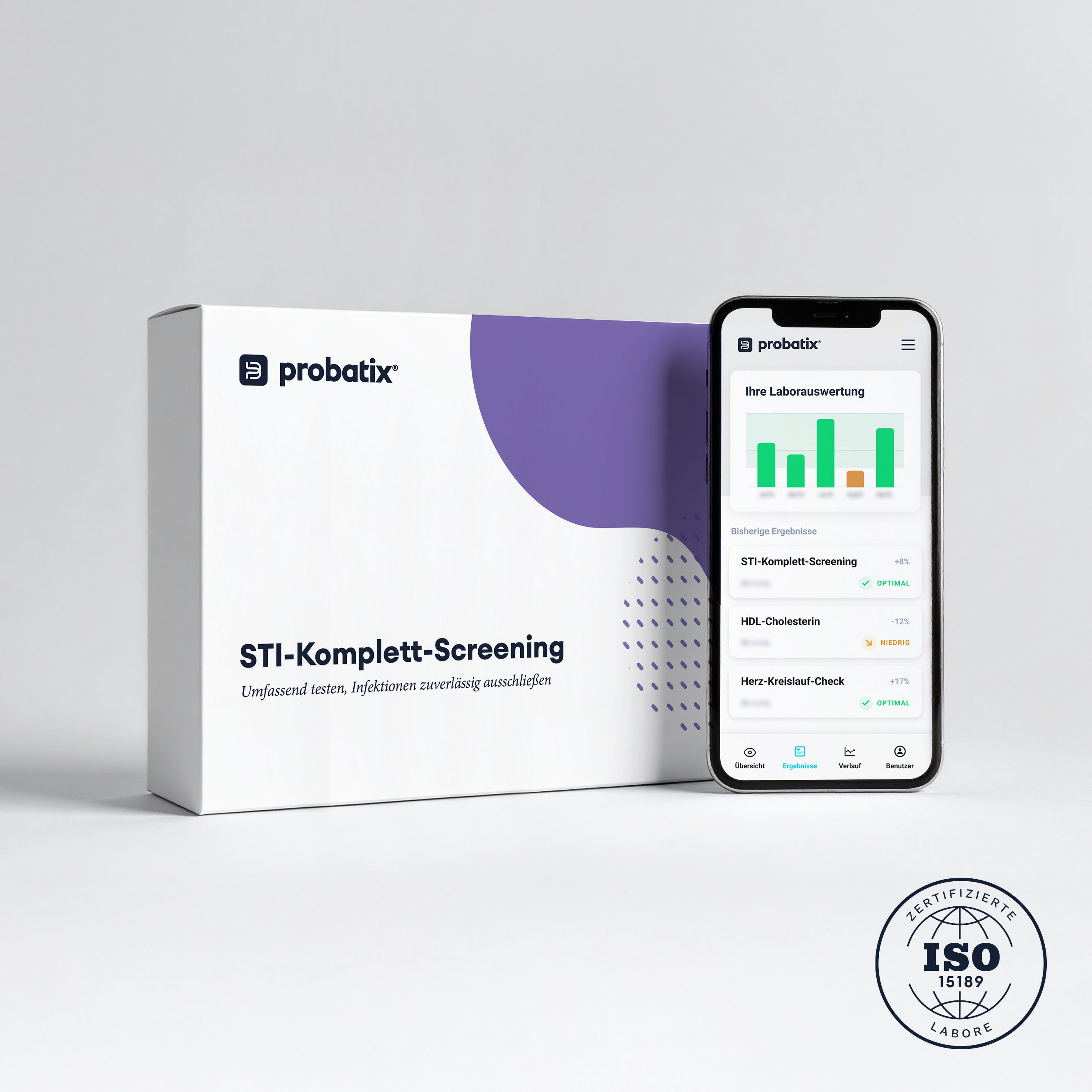
STI Check Complete: All details about the test
What benefits does this test offer me?
What benefits does this test offer me?
Sexually transmitted infections (STIs) are among the most common infectious diseases worldwide and often go unnoticed. According to the World Health Organization (WHO), more than 1 million people are infected with an STI each year – many without knowing it. Untreated infections can have serious health consequences and be transmitted unnoticed.
STIs often go undetected
Many sexually transmitted infections initially cause no or only nonspecific symptoms. Studies show:
- Up to 80% of women with gonorrhea have no symptoms.
- Herpes viruses (HSV1 & HSV2) can remain unnoticed in the body for years and only break out later.
- Chlamydia is the most common bacterial STI and remains asymptomatic in up to 70% of women and 50% of men .
- Syphilis can go unnoticed in its early stages and cause severe organ damage if left untreated.
Without a reliable sexually transmitted diseases test, many infections remain undetected and can be transmitted.
Serious Consequences of Untreated STIs
Untreated sexually transmitted infections can cause long-term health problems:
- Infertility: Chlamydia, gonorrhea, and Mycoplasma genitalium can cause inflammation in the genital tract, which can lead to infertility.
- Chronic Pain: Ureaplasmas and mycoplasmas can trigger chronic inflammation, causing discomfort in the urinary and genital areas.
- Pregnancy complications: Infections such as cytomegalovirus (CMV) or syphilis can be transmitted to the child during pregnancy and lead to miscarriages or developmental disorders.
- Higher HIV risk: STIs increase the risk of HIV infection by 2 to 5 times.
Why a comprehensive STI test is crucial
A standard STI test often covers only a few pathogens. Many infections, especially those caused by viruses like herpes or CMV, remain undetected. The STI-Check Complete offers a particularly comprehensive analysis – including pathogens that are not tested in many routine examinations.
Regular STI testing protects your health
Health experts recommend regular testing, especially if you:
- are sexually active and have multiple partners.
- had unprotected sexual intercourse.
- notice symptoms such as burning during urination, unusual discharge, or skin changes.
- want to be sure that there is no unnoticed infection.
The STI-Check Complete enables a discreet, reliable, and comprehensive check for the most important sexually transmitted pathogens – conveniently from home.
What do the measured values mean?
What do the measured values mean?
Cytomegalovirus is a widespread herpes virus that usually goes unnoticed. However, for people with weakened immune systems or during pregnancy, an infection can be relevant.
A PCR test can directly detect the virus in the body and helps to identify an active infection early.
Haemophilus ducreyi
Haemophilus ducreyi is the bacterium that causes the so-called soft chancre (chancroid) – a rare but painful sexually transmitted infection.
The disease leads to painful ulcers in the genital area. A PCR test detects the DNA of the pathogen and enables targeted treatment.
Varicella-Zoster Virus (VZV)
Varicella-zoster virus belongs to the herpesvirus family and causes chickenpox and later in life shingles. After the initial infection, the virus remains in the body for life and can become active again.
A PCR test detects the viral DNA and helps to reliably diagnose active infections.
Chlamydia trachomatis
Chlamydia trachomatis is a bacterium that causes one of the most common sexually transmitted infections. Many affected individuals initially have no symptoms, which is why the infection often goes unnoticed.
If left untreated, it can lead to inflammation of the urinary tract or reproductive organs and, in the long term, impair fertility. A PCR test reliably detects the DNA of the pathogen and enables early treatment.
Neisseria gonorrhoeae
Neisseria gonorrhoeae is the bacterium that causes the sexually transmitted disease gonorrhea. Typical symptoms include pain during urination or unusual discharge, but often the infection occurs without any symptoms.
If untreated, it can cause inflammation of the genital organs and complications such as infertility. Modern PCR tests detect the pathogen's DNA quickly and reliably.
Mycoplasma genitalium
Mycoplasma genitalium is a bacterium that can cause inflammation of the urethra and genital organs. The infection often goes unnoticed or shows only mild symptoms.
Since the pathogen is difficult to culture, detection is usually done via a PCR test that identifies the bacterium's genetic material. Early diagnosis helps to avoid potential complications.
Trichomonas vaginalis
Trichomonas vaginalis is a single-celled parasite that causes a sexually transmitted infection. Typical symptoms can include itching, burning, or unusual discharge, but often the infection remains asymptomatic.
A PCR test can reliably detect the DNA of the parasite. Early treatment prevents the transmission of the infection and possible inflammation in the genital area.
Mycoplasma hominis
Mycoplasma hominis is one of the smallest known bacteria and can occur in the genital tract. In some people, it causes inflammation of the urinary tract or genital organs.
Since the bacteria are difficult to detect, diagnosis is usually made via PCR tests. Detection can help clarify possible causes of discomfort or infections.
Ureaplasma urealyticum
Ureaplasma urealyticum is a bacterium that can naturally occur in the genital tract. However, in certain cases, it can cause inflammation of the urinary tract or genital organs.
A PCR test detects the genetic material of the pathogen and helps to assess whether there is an infection that should be medically treated.
Ureaplasma parvum
Ureaplasma parvum belongs to a group of bacteria that are commonly found in the genital tract. However, in some people, it can cause inflammation or be associated with complaints in the urogenital area.
Detection is usually carried out using a PCR test, which identifies the DNA of the pathogen and enables an accurate diagnosis.
Herpes Simplex Virus 1 (HSV-1)
Herpes simplex virus type 1 usually causes cold sores but can also trigger infections in the genital area. After an initial infection, the virus remains in the body for life and can become active again during stress or a weakened immune system.
A PCR test directly detects the viral DNA and helps to reliably diagnose an active infection.
Herpes Simplex Virus 2 (HSV-2)
Herpes simplex virus type 2 is a common cause of genital herpes. Typical symptoms include painful blisters or skin changes in the genital area.
The virus remains permanently in the body after infection and can recur. PCR tests allow for rapid and reliable detection of the virus DNA.
Treponema pallidum (Syphilis)
Treponema pallidum is the bacterium that causes the sexually transmitted disease syphilis. The disease progresses in several stages and can have serious health consequences if left untreated.
A PCR test can directly detect the pathogen, especially in early stages of infection. Timely diagnosis allows for effective treatment with antibiotics.
Why is this test important?
Why is this test important?
When should I take this test?
When should I take this test?
An STI test is important if there is a risk of infection – often an infection goes unnoticed.
You should take the STI-Check Complete if you:
- Had unprotected sexual intercourse
- Have changing or new partners
- Notice symptoms like burning, discharge, or skin changes
- Simply want to ensure that there is no infection
Regular tests help protect your health and that of your partners.
Why test with Tasso+?
Why test with Tasso+?
Where can I find the instructions?
Where can I find the instructions?
Bei Fragen hilft Ihnen auch immer gerne unser wunderbarer Support weiter: support@probatix.de
FAQ - More Frequently Asked Questions about the Test
FAQ - More Frequently Asked Questions about the Test
How does the STI-Check Complete work?
You collect a urine sample at home, send it to the lab, and receive your result discreetly online. A detailed instruction is included.
Which infections are tested in the sexually transmitted diseases test?
The test screens for 13 common STIs, including chlamydia, gonorrhea, mycoplasma, herpes viruses (HSV1 & HSV2), syphilis, and other pathogens.
When should I get tested for sexually transmitted diseases?
After unprotected intercourse, with new or multiple partners, if symptoms occur, or for regular monitoring of your sexual health.
How long does it take to receive my result?
Once the sample is received in the lab, the analysis usually takes a few business days. You can access the result online.
How reliable is the sexually transmitted diseases test?
The analysis is conducted in a certified laboratory with high precision and medical accuracy.
Is the test anonymous and discreet?
Yes, the test box is delivered in neutral packaging, the sample processing is confidential, and your result is only accessible to you.
Why is a comprehensive sexually transmitted diseases test sensible?
Many STIs are asymptomatic or resemble other infections. The STI Check Complete covers bacterial and viral pathogens and provides a comprehensive diagnosis.