Our customer reviews
Unsure about the selection?

More products



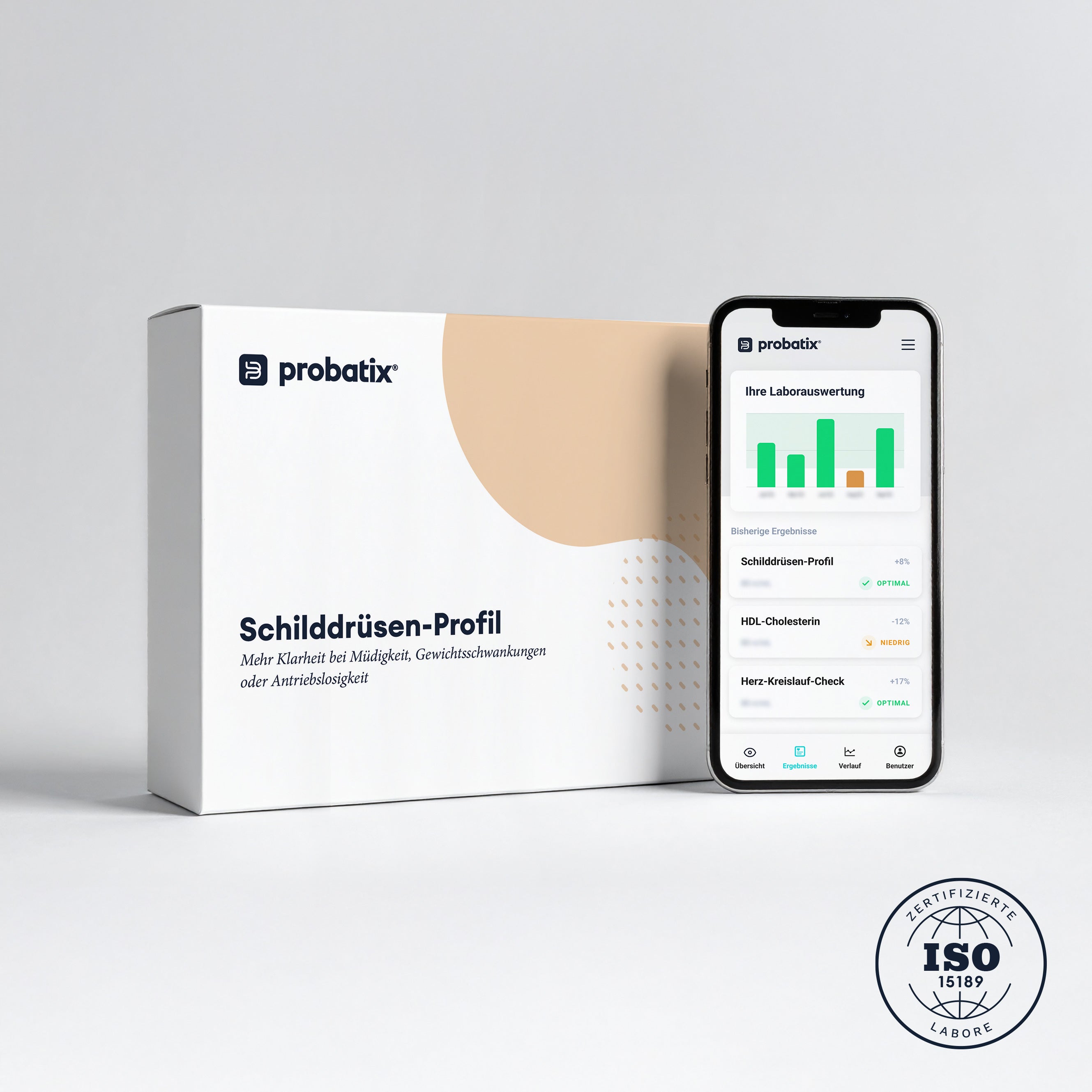

















Thyroid Profile: All details about the test
What benefits does this test offer me?
What benefits does this test offer me?
Balance your thyroid health – with clear insights into your hormone levels.
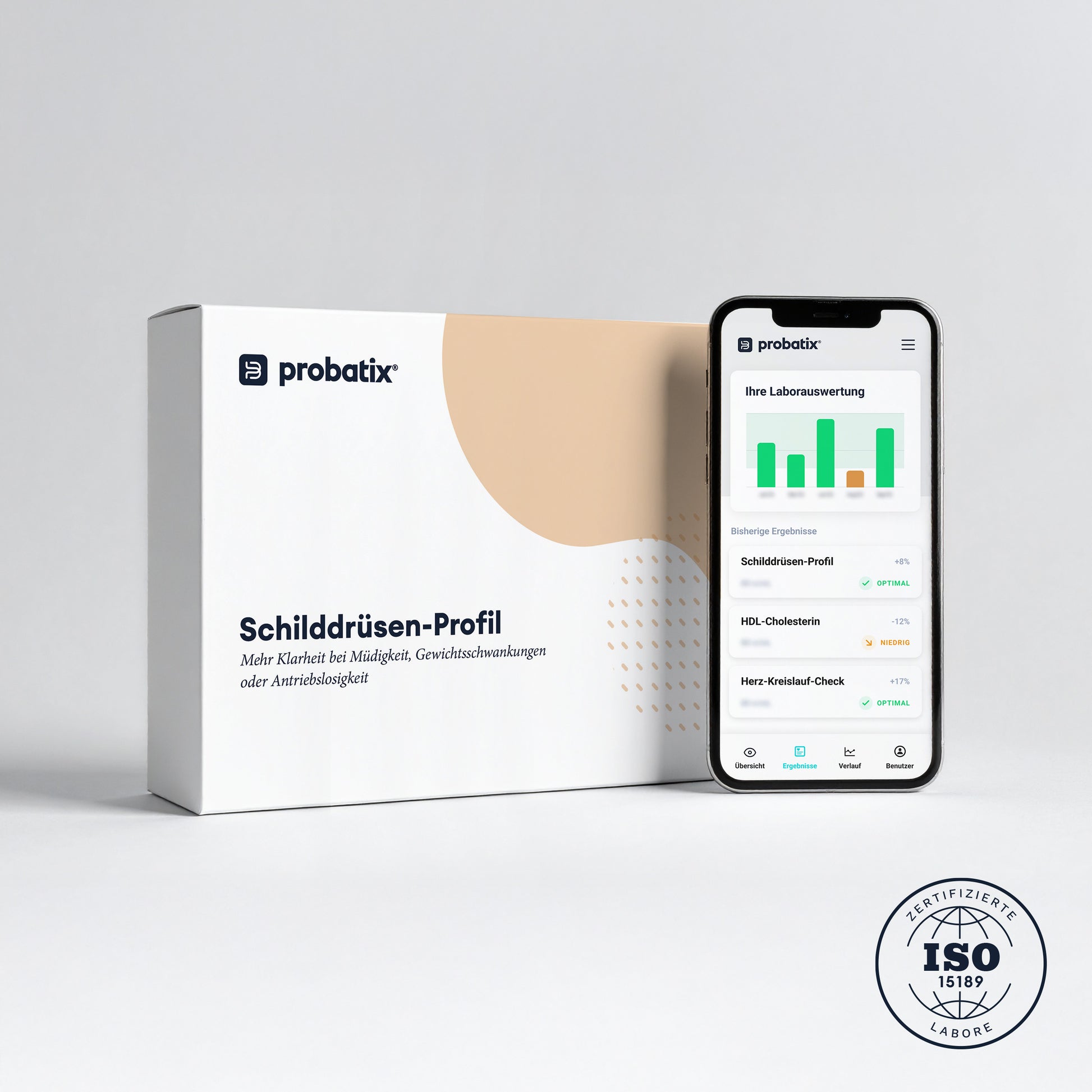
The Thyroid Profile offers a comprehensive analysis of the key thyroid values: TSH, fT3, fT4, and TPO antibodies (thyroid peroxidase antibodies). These values provide you with a clear basis to identify potential imbalances and better understand your thyroid function.
Why test now? Thyroid disorders often develop gradually and can significantly affect your well-being. With this test, you will find out early if your values are within the normal range and can take timely action.
Your benefits:
- Comprehensive results: Analysis of relevant thyroid values including antibodies.
- Simple and convenient: Sample collection flexibly and discreetly from home.
- Clear Feedback: Your individual report shows you your values compared to the reference ranges.
Find out about your thyroid health – with the Thyroid Profile from Probatix.
What do the measured values mean?
What do the measured values mean?
TSH (Thyroid-stimulating hormone) is produced in the pituitary gland and controls the activity of the thyroid gland. It stimulates the thyroid to produce the hormones T3 and T4, which influence metabolism and many body functions.
High TSH levels usually indicate an underactive thyroid, as the body tries to boost hormone production. Low TSH levels, on the other hand, suggest an overactive thyroid.
fT3 (free triiodothyronine)
fT3 is the active form of the thyroid hormone that acts directly in the cells and regulates metabolism. It influences heart rate, energy consumption, digestion, and many other body functions. A large part is produced by the conversion of the hormone T4 into T3 in the liver and kidneys.
Elevated fT3 levels usually indicate hyperthyroidism, while low levels may suggest hypothyroidism or a disturbance in the conversion of T4 to T3.
fT4 (free thyroxine)
fT4 is the precursor of the active hormone T3 and is predominantly produced by the thyroid gland. It circulates in the blood and can be converted into T3 in the organs to stimulate metabolism.
High fT4 levels typically indicate hyperthyroidism. Low levels, on the other hand, suggest hypothyroidism.
TPO / MAK (Autoantibodies against Thyroid Peroxidase)
TPO or MAK antibodies target the enzyme thyroid peroxidase, which is needed in the thyroid gland for the production of thyroid hormones. If such antibodies are formed, the immune system attacks the thyroid gland – an indication of an autoimmune disease.
They most commonly occur in Hashimoto's thyroiditis or Graves' disease. A positive test thus indicates such an autoimmune reaction, even if the level of antibodies does not always directly correlate with the severity of the disease.
Why is this test important?
Why is this test important?
When should I take this test?
When should I take this test?
A thyroid profile can be useful in the following symptoms or situations:
- Unexplained weight gain or loss
- Persistent fatigue or lack of energy
- Mood swings, nervousness, or depression
- Changes in heart rate
- Hair loss, brittle nails, or dry skin
- Irregular menstrual cycles in women
- Family history of thyroid disorders
Important: Discuss your results with a doctor to clarify the causes and initiate appropriate measures.
Where can I find the instructions?
Where can I find the instructions?
Bei Fragen hilft Ihnen auch immer gerne unser wunderbarer Support weiter: support@probatix.de
FAQ - More Frequently Asked Questions about the Test
FAQ - More Frequently Asked Questions about the Test
1. What is tested in the thyroid profile?
The thyroid profile measures the thyroid hormones TSH, free T3, and free T4, as well as antibodies (TPO-AK). This provides you with a comprehensive analysis of your thyroid function.
2. Who is the thyroid profile suitable for?
The test is suitable for anyone who wants to check their thyroid levels more closely – especially if there is a suspicion of an autoimmune disease such as Hashimoto's or Graves' disease.
3. Why are the antibodies in the thyroid profile important?
TPO antibodies can indicate autoimmune diseases of the thyroid, which are often the cause of underactive or overactive thyroid.
4. What symptoms indicate a thyroid disorder?
Typical signs are fatigue, weight gain, hair loss, nervousness, or palpitations. A thorough examination of thyroid levels helps to clarify the causes.
5. How is the thyroid profile conducted?
The procedure is simple: You take a small blood sample at home, which is then analyzed in a specialized laboratory.
6. How long does it take to receive my results?
Typically, your results are available digitally in your personal Probatix dashboard within a few days.
7. What do the test results mean?
The results indicate whether your thyroid levels are within the normal range or if there are abnormalities suggesting hypothyroidism, hyperthyroidism, or an autoimmune disease.
8. What can I do with the results?
The results provide a solid basis for discussing the next steps with your doctor – such as medication therapy for a thyroid disorder.
9.How often should I conduct the thyroid profile?
A regular check-up is recommended, especially if a thyroid disorder is already known or there is a family history.

Can I have a blood test without a general practitioner?
Yes, certain laboratory tests can now be conducted without a direct appointment with your general practitioner through validated home tests. You take a small blood sample at home and have it analyzed in a medical laboratory. This way, you can keep an eye on important health values.

How reliable are at-home blood tests?
The crucial factor is that the analysis is conducted in a quality-assured laboratory using standardized methods. Then, blood tests with capillary blood are generally just as reliable as a blood draw in the practice. With clear instructions and certified partner laboratories, Probatix ensures that you can rely on your results.

Why should I take a test with Probatix instead of at the doctor's?
At Probatix, you can start blood tests flexibly at home - without waiting rooms, with clear step-by-step instructions and analysis in certified specialist laboratories. The results are prepared digitally, comprehensibly, and trackably, so you can easily monitor developments over time. This way, you can complement traditional medical care with comfortable, data-supported monitoring of your health with Probatix.